


Mexico City Parks: The Alameda
- Jenny Rose

- Jun 12, 2025
- 3 min read
Updated: Aug 29, 2025

When I am out of Mexico City for an amount of time I miss it. I miss the thumping chaos and rich culture of Mexico City. I miss the food, the colors, the traditions, the rhythm of life, the music and I miss the parks.
There are numerous parks all over Mexico City. Some are large like Parque de Chapultepec and some are small like Parque España in Condesa. They are all spots of greenery that offer much to all who enjoy them, offering a sanctuary of nature within this congested metropolis, and a glimpse into everyday life in Mexico City.
There are too many parks to count and think that to begin we should start in the Centro Historico and then move out from there to explore the rest. To begin, let's look at Alameda Central because it is the oldest park in the Americas. It is located next to Palacio Bellas Artes in Delegación Cuauhtémoc between Avenidas Juarez and Hidalgo. It has a rich history with many changes that have occurred throughout the centuries.
Originally, the area was used as an Aztec marketplace. On July 11, 1592 Viceroy Luis de Velasco II ordered the construction of the park, which at that time marked the western edge of the city, for the city residents where they could enjoy community events amidst fountains, poplar trees and ponds of fish.
The name Alameda comes from the Spanish word álamo, which means poplar tree, many of which were planted here as was custom at the time having been brought from Spain and Morocco.
It was during this time that some rather darker events occurred, too. During the years of the Mexican Inquisition, a small area in the western section of the park was known as El Quemadero (The Burning Place). It is an area in front of Convent de San Diego where those convicted during the auto-de-fe were publicly burned at the stake.
In 1770 and 1775, Viceroy Marqués de Croix had the area torn up to expand the park. The layout of the promenades were redesigned and five fountains carved in stone with mythological themes were constructed. The park was expanded again in 1791, when the Count of Revillagigedo built a wooden fence around the park to make it exclusive for the nobility.
By the 19th century the Alameda changed drastically. Mexican Independence was won in 1821 and the Alameda became a center for popular celebrations, and by the end of the century it had opened up to all social classes. A bandstand was added as were more statues, gas lamps were installed in 1868, which were later replaced by electrical lighting in 1892.
In the early 20th century, in homage to Benito Juarez, one of Mexico’s most beloved presidents, Porfirio Diaz commissioned the construction of the Hemiciclo a Juárez in 1906. It was officially dedicated in 1910. It is a large white semi-circular monument located in the southern section of the park located facing Avenida Juarez. Today it is boarded up to protect against vandalism of protesters who spray paint their words and images of disconent and protest.
In 2012, the park went through major renovations which included replacing the damaged pavement with marble, planting of new trees and other plants, new light posts, and improvement of existing park features, such as benches and repairing fountains.
A walk through the park is a mish-mosh of Europe meets Mexico set in a part of the city where the energy is antique with hints of ghosts from colonial and pre-hispanic times intertwined with European art and modern-day Mexican daily life.
***all photos by JennyRose



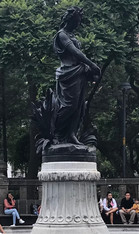






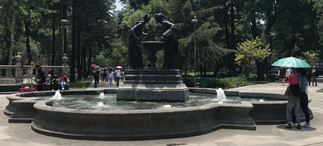















The park is always bustling with activity of the vendors, families enjoying the sights, couples snuggling on benches, activists protesting injustices posting faces of missing people, tourists in safari hats, shorts and birkenstocks, and the city workers in orange jumpsuits sweeping with brooms made of tree branches while stone-faced uninterested police stand nearby amidst a crowd watching clowns perform a song and dance. As I walked along the scene an old man bustled by me with an empty water garrafón housing a giant grayish-brown scaled snake leaving me most intrigued.
That is what I love about life in Mexico City. It is overstimulation of the senses and like something out of a Fellini movie with random things marching by. The experience is surreal, but grounded in realness of the earth, the plants, animals and life enjoyed in the park.
Sources:
“Alameda Central.” Wikipedia, Wikimedia Foundation. 1 February 2025, https://en.wikipedia.org/wiki/Alameda_Central


Comments